The Slow Boat Route at a Glance
- Start: Chiang Rai or Chiang Khong, Thailand
- Border: Chiang Khong to Huay Xai, over the 4th Thai–Lao Friendship Bridge
- Day 1: Huay Xai to Pak Beng, about 6 to 7 hours on the river
- Overnight: Pak Beng, the halfway village where every boat stops
- Day 2: Pak Beng to Luang Prabang, about 6 to 8 hours
- Finish: the slow boat pier about 10 km north of Luang Prabang’s old town
Journey times change with the season and the water level. Boats do not run after dark, which is why the trip always takes two days.
Step 1: Chiang Rai to the Border at Chiang Khong
The closest Thai city to the border is Chiang Rai. From there it is about two hours east to Chiang Khong, the Thai town facing Huay Xai across the Mekong.
- Local bus: the cheapest option. Buses leave Chiang Rai Bus Terminal 1 roughly every hour from early morning and take 2 to 2.5 hours.
- Minivan or taxi: faster, about 1.5 hours, and it drops you at the immigration checkpoint rather than in town.
- Hotel pickup: our slow boat trips collect you from your Chiang Rai hotel before dawn, so you reach the border as it opens and make the morning boat.
Coming from Chiang Mai? The drive is much longer, so most people either spend a night in Chiang Rai or take our three-day slow boat from Chiang Mai, which includes a night in Huay Xai. With a day to spare, the Phu Chi Fa border region is a short detour from Chiang Khong.
Step 2: Crossing the Border to Huay Xai
At the Chiang Khong checkpoint you are stamped out of Thailand, then buy a ticket for the shuttle bus across the 4th Thai–Lao Friendship Bridge (you cannot walk across). On the Lao side, Huay Xai immigration issues the visa on arrival.
- Pay the visa fee in US dollars, in clean, unfolded notes. Thai baht is accepted, but at a poor exchange rate.
- Bring a passport photo and a passport valid for at least six months.
- Many nationalities can apply for an e-visa in advance instead. Check our Laos visa guide before you travel.
For opening hours and the other crossing points, see our Laos border crossing guide.
Step 3: Buying Your Slow Boat Ticket in Huay Xai
The slow boat pier is about 10 km from the border post. Tuk-tuks wait outside the immigration hall and run to the pier at a fixed fare. Tickets are sold at the ticket office at the pier, either for Pak Beng only or through to Luang Prabang.
- Departure: boats leave in the morning, usually between about 9:00 and 11:30 AM, and public boats sometimes wait until they are full. Get to the pier early for a good seat.
- Package tickets: agencies in Chiang Rai and Chiang Khong sell combined tickets. Before you pay, check what is included (transfer, border help, lunch, the boat ticket) and whether the ticket covers one day or both.
- Booked with us: your boat ticket is arranged for you, and our Huay Xai team takes you to the pier, with time to buy a SIM card, change money and pick up your lunch box.
Step 4: Day One, Huay Xai to Pak Beng
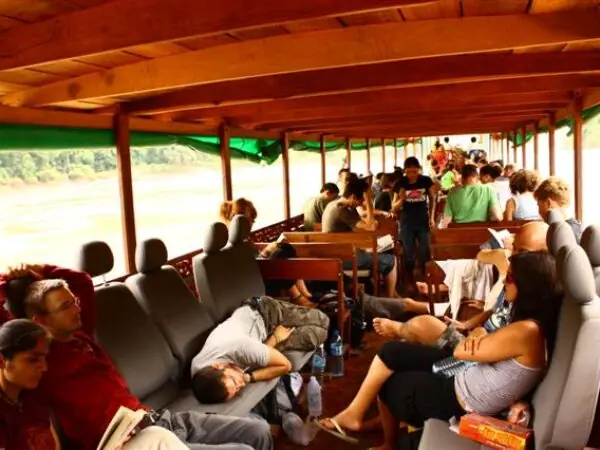
The first day is about 6 to 7 hours of cruising downstream. Slow boats are long wooden vessels, most fitted with old car seats or padded benches, and on public boats seating is first come, first served.
- Sit in the front or middle of the boat. The engine at the back is loud and smoky.
- A small counter sells Beerlao, soft drinks, instant noodles and crisps. Buy sandwiches, fruit and water in Huay Xai before you board.
- Every boat has a basic toilet at the back.
In the late afternoon the boat docks at Pak Beng. Everyone gets off here, because boats do not travel after dark. The village exists mainly for slow boat passengers, with guesthouses and restaurants along the road up from the pier. Rooms are easy to find, but from November to February booking ahead saves haggling at the pier. Our Pak Beng guide covers the pier, where to stay and what to do in the evening.
Step 5: Day Two, Pak Beng to Luang Prabang
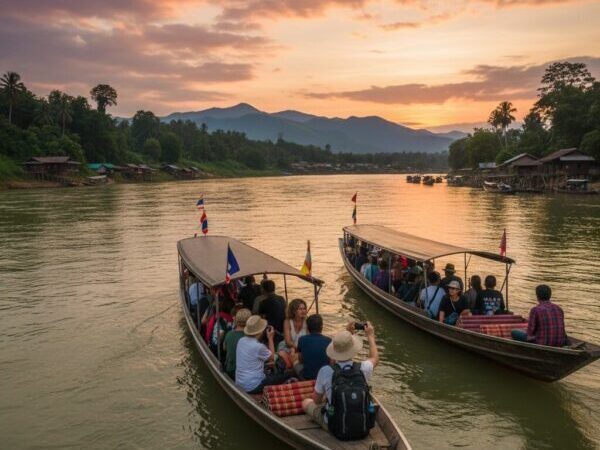
Boats leave Pak Beng between about 8:00 and 9:00 AM; be at the pier half an hour early. Day two is many travellers’ favourite: the river narrows, limestone cliffs rise straight out of the water, and you pass fishermen casting nets, water buffalo in the shallows and small bamboo villages.
Shortly before Luang Prabang, many boats slow down at the Pak Ou Caves, filled with thousands of Buddha statues. You arrive in the late afternoon at the slow boat pier about 10 km north of town (large boats are kept away from the UNESCO-listed old town). Shared tuk-tuks from the terminal take about 15 minutes into the centre.
What to Expect on Board
Life on the slow boat is unhurried. Boats are open-sided with room to move around, and you share them with other travellers and often with local families, monks and traders carrying goods between villages. Expect monks in saffron robes on the banks, children waving from the shore and water buffalo cooling off in the shallows.
There is no Wi-Fi and rarely a charging point, which is half the appeal: read, play cards, talk to the people around you, or just watch the river go by.
Public, Private or Luxury Slow Boat?
Public slow boat. The authentic option most independent travellers take: simple seating, snacks for sale, and a full boat of locals and backpackers.
Private and premium boats. More space and fewer passengers, with lunch, tea and coffee on board and optional stops such as a riverside village and the Pak Ou Caves.
Luxury slow boat. Cushioned lounge seats, hot lunches, a hotel room in Pak Beng and guided stops, for travellers who want the river to be a highlight of the holiday rather than a transfer. Read more in our luxury and private slow boat guide.
We offer all of them with reliable, trusted operators and full support throughout your journey.
Life Along the Mekong
The Mekong is still the main road for much of northern Laos, used for trade and travel between villages with no road connection. That is why the slow boat is a cultural experience as much as a transfer. You pass stilted wooden houses, peanut and vegetable gardens on the sandbanks, and limestone formations towering over the river.
Travelling the other way? Upstream boats from Luang Prabang are quieter and take a little longer: see our guide to the slow boat from Luang Prabang to Thailand. Still choosing between boat, bus and train? Our Chiang Rai to Luang Prabang guide compares all three.
Practical Tips for the Slow Boat
- Book ahead from December to February, when boats and Pak Beng rooms fill up.
- Bring a cushion. Seven hours on a bench or an old car seat is long; cheap cushions are sold in Huay Xai.
- Dress in layers. Mornings on the river are cool and misty, especially in December and January, while afternoons get hot.
- Protect yourself from the sun. It reflects off the water, so bring a hat, sunglasses and sunscreen.
- Carry a power bank. Charging points on board are rare.
- Bring cash. ATMs in Pak Beng are few and unreliable. Get enough Lao kip in Huay Xai for your room, dinner, breakfast and the tuk-tuk in Luang Prabang, plus US dollars for the visa.
- Pack entertainment. Download podcasts, bring a book or a deck of cards.
- Go with the flow. Departure times shift and boats fill up. The slow pace is the point.